
Traditional model
- Design
- Release
- Production run
- Measure
- Cpk 1.12 · fail
- Rework
Linear. Email-driven. Discovered in week six. 10–14 weeks to approval, with £50K–£200K redesign risk per part.
Agentic AI operating system for manufacturing
CADENCE is the second brain of the factory. Specialist AI agents sense what is happening across design, production and supply, negotiate solutions with each other, and bring engineers decisions they can trust. It starts today with first-time-right PPAP approval for automotive suppliers.
The shift
Engineers set tolerances without knowing whether their machines can hold them. The gap shows up after the production run, when the PPAP fails and weeks of documents have to be redone. CADENCE moves the capability check to the moment the drawing is uploaded.
Traditional model
Linear. Email-driven. Discovered in week six. 10–14 weeks to approval, with £50K–£200K redesign risk per part.
The CADENCE model
Continuous. Agent-driven. Resolved in minutes. Capability is proven before money is spent on production.
The second brain
An octopus keeps most of its neurons in its arms. Each arm senses and acts on its own while the brain sets the goal. CADENCE works the same way: a central AI OS holds business context and objectives, and specialist agents work inside each system and on the shop floor.
CADENCE AI OS
Holds what the business is trying to achieve and everything it has learned, so every agent works toward the same objective.
Specialist agents in every system
Each agent understands one domain deeply, reads its own system and acts locally, then reports back to the brain.
The physical AI ecosystem
Intent from the brain reaches the machines, robots and people who make the part, and what they measure flows back.
Available now · Agentic PPAP
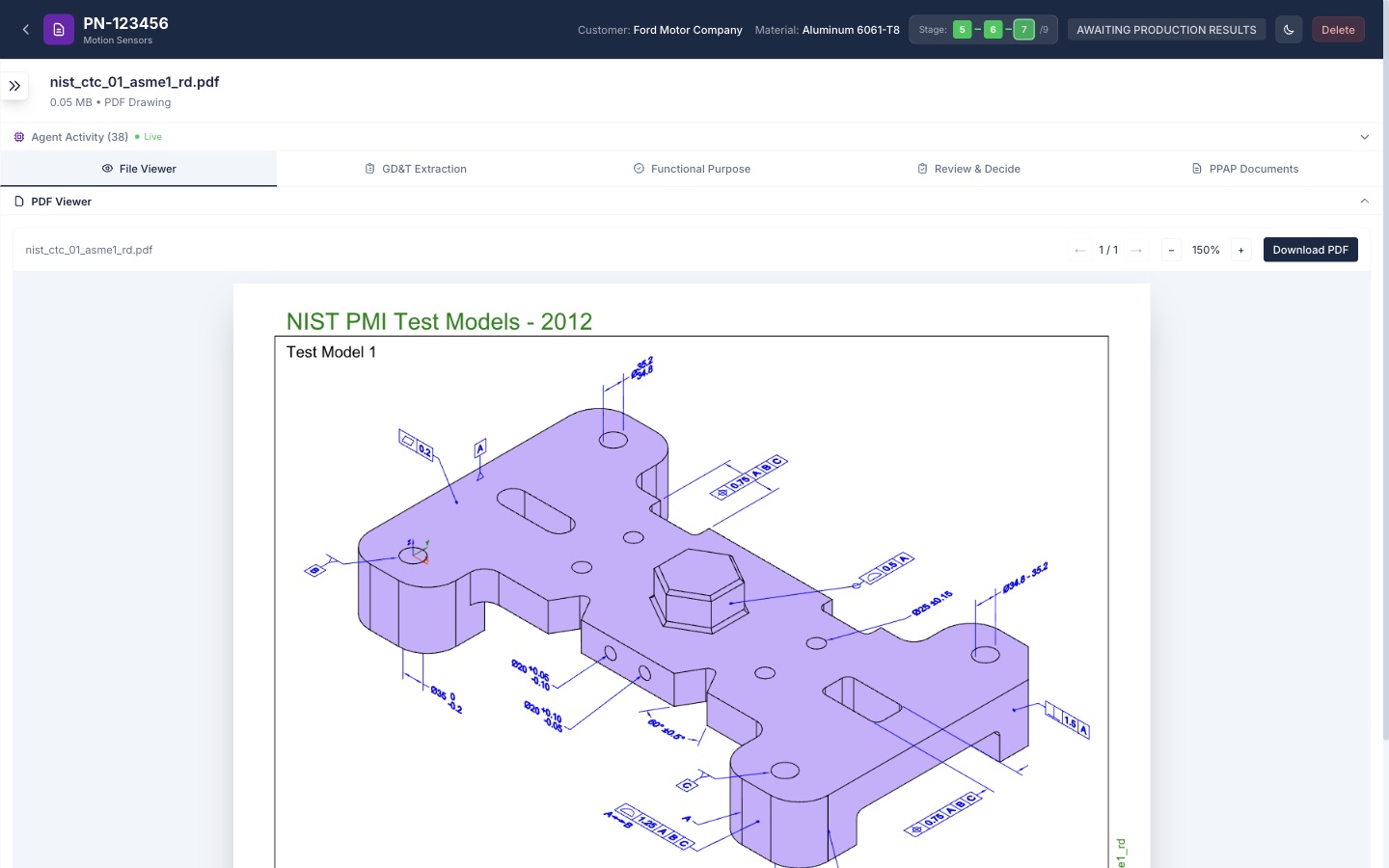
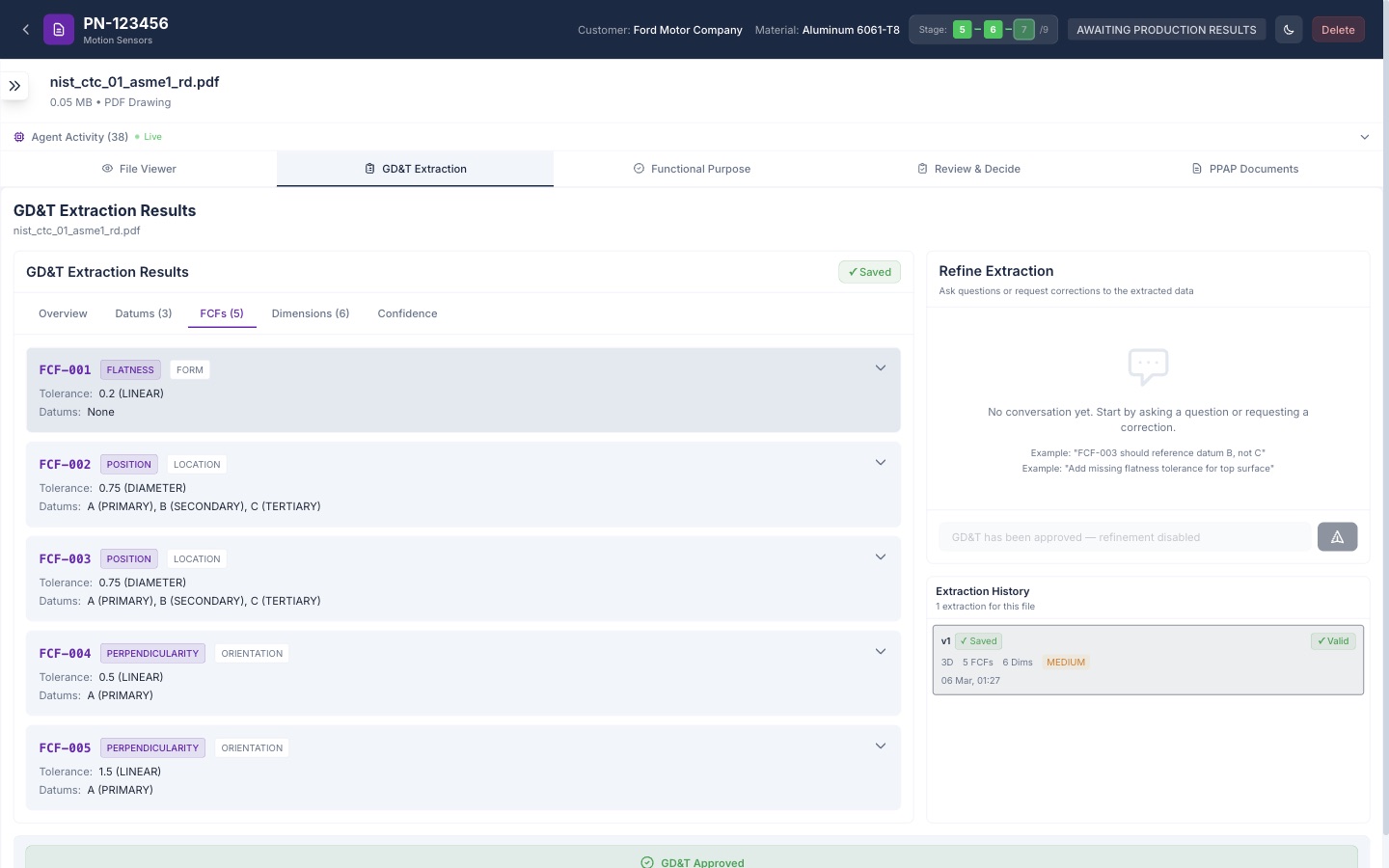
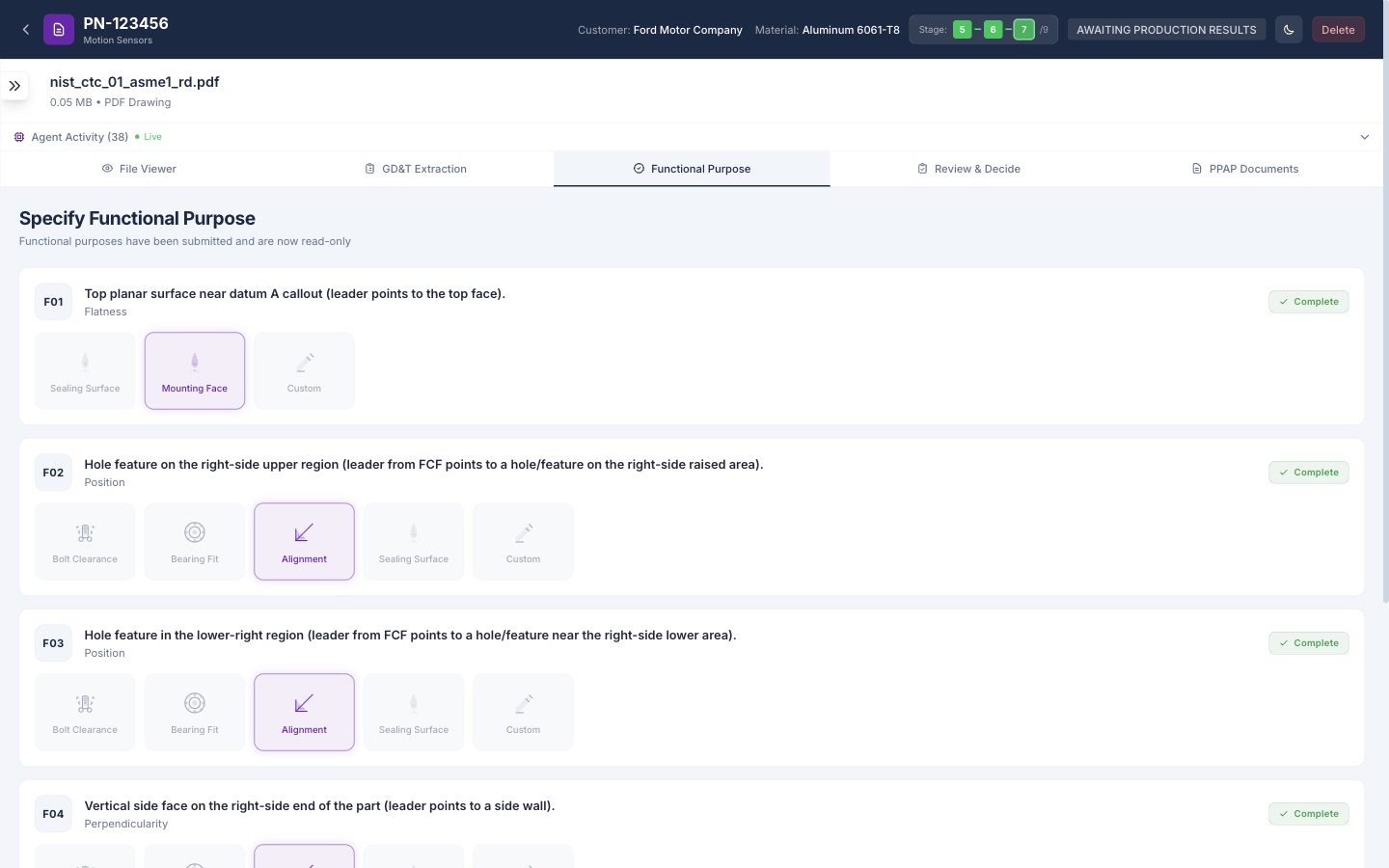
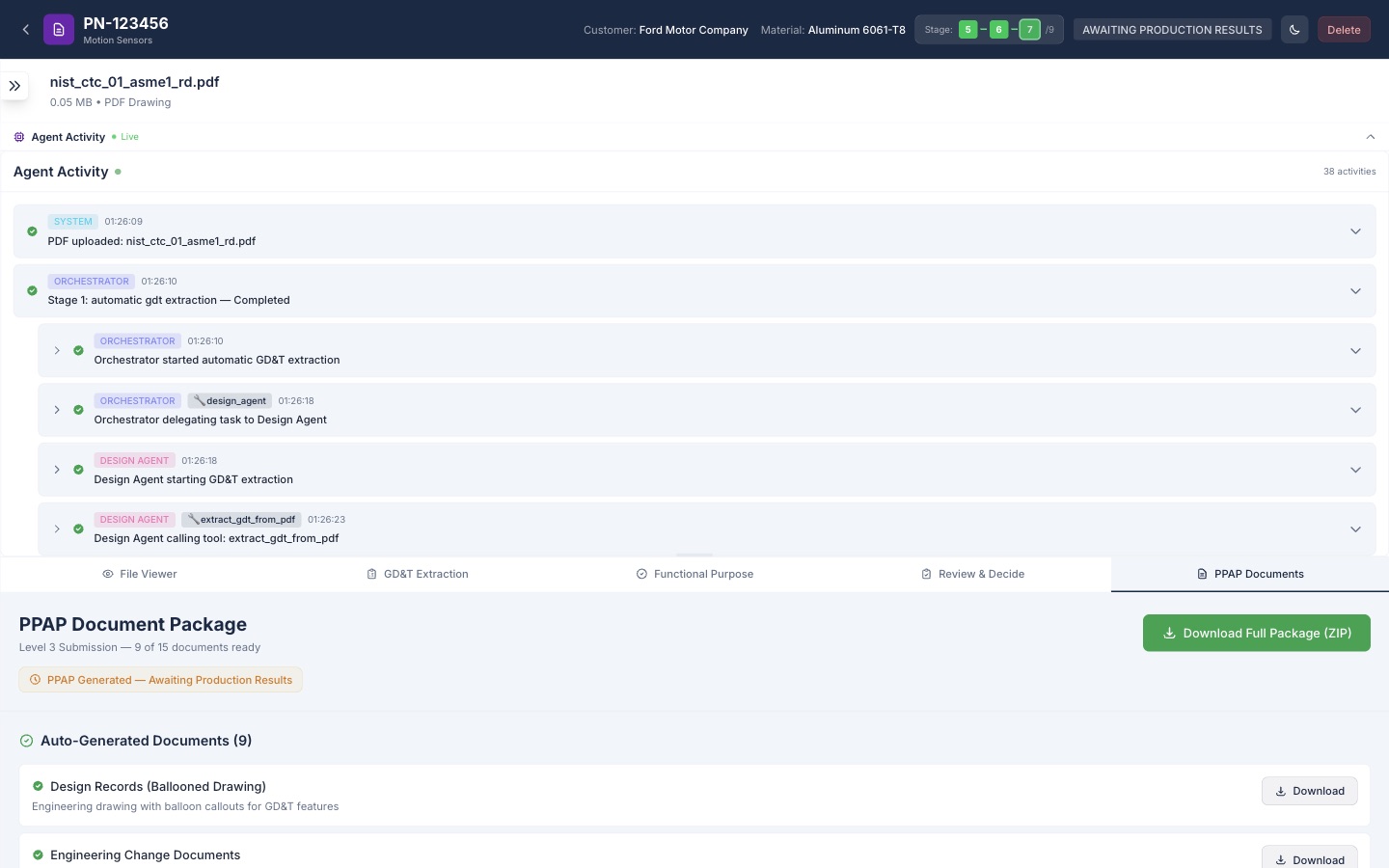
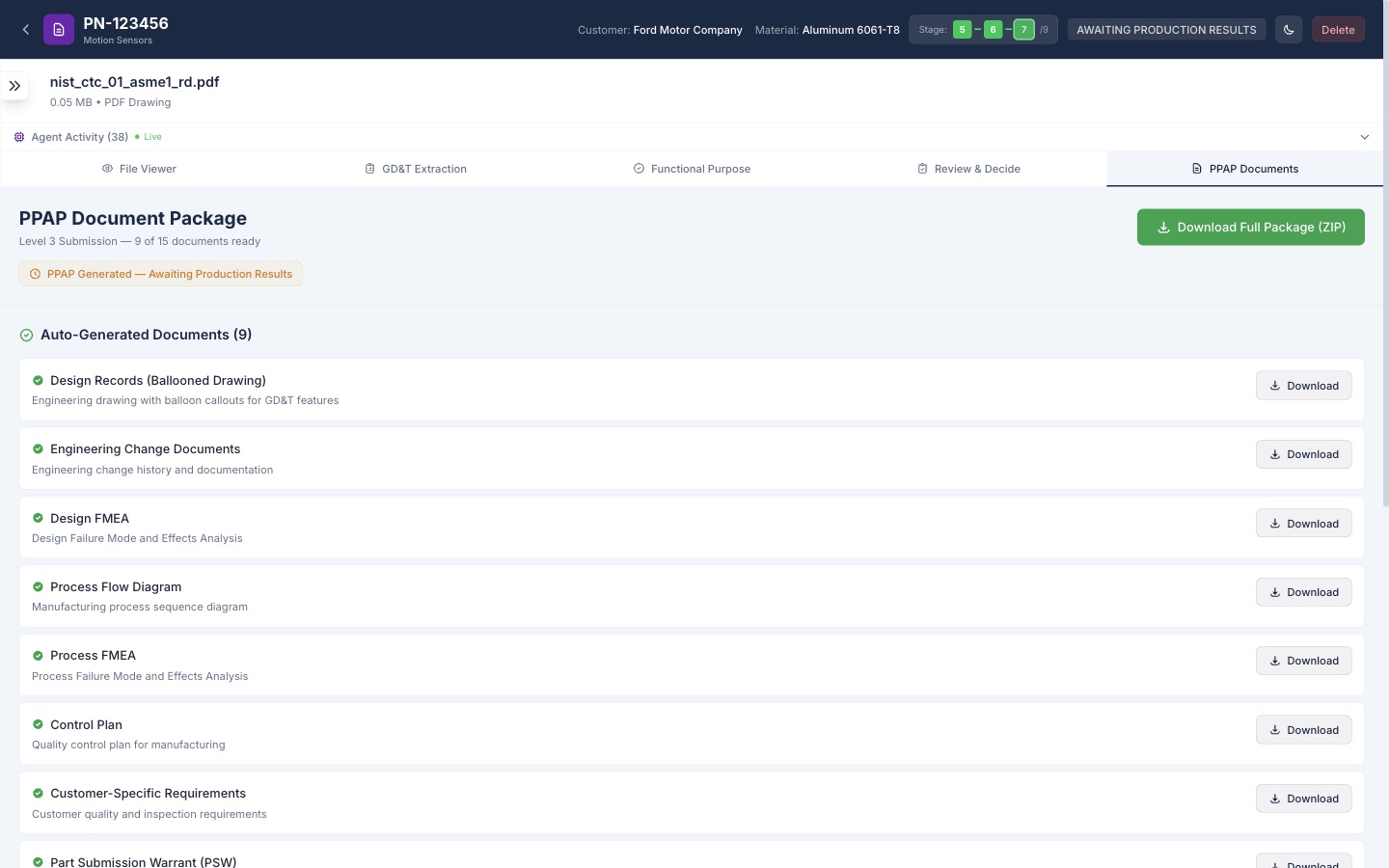
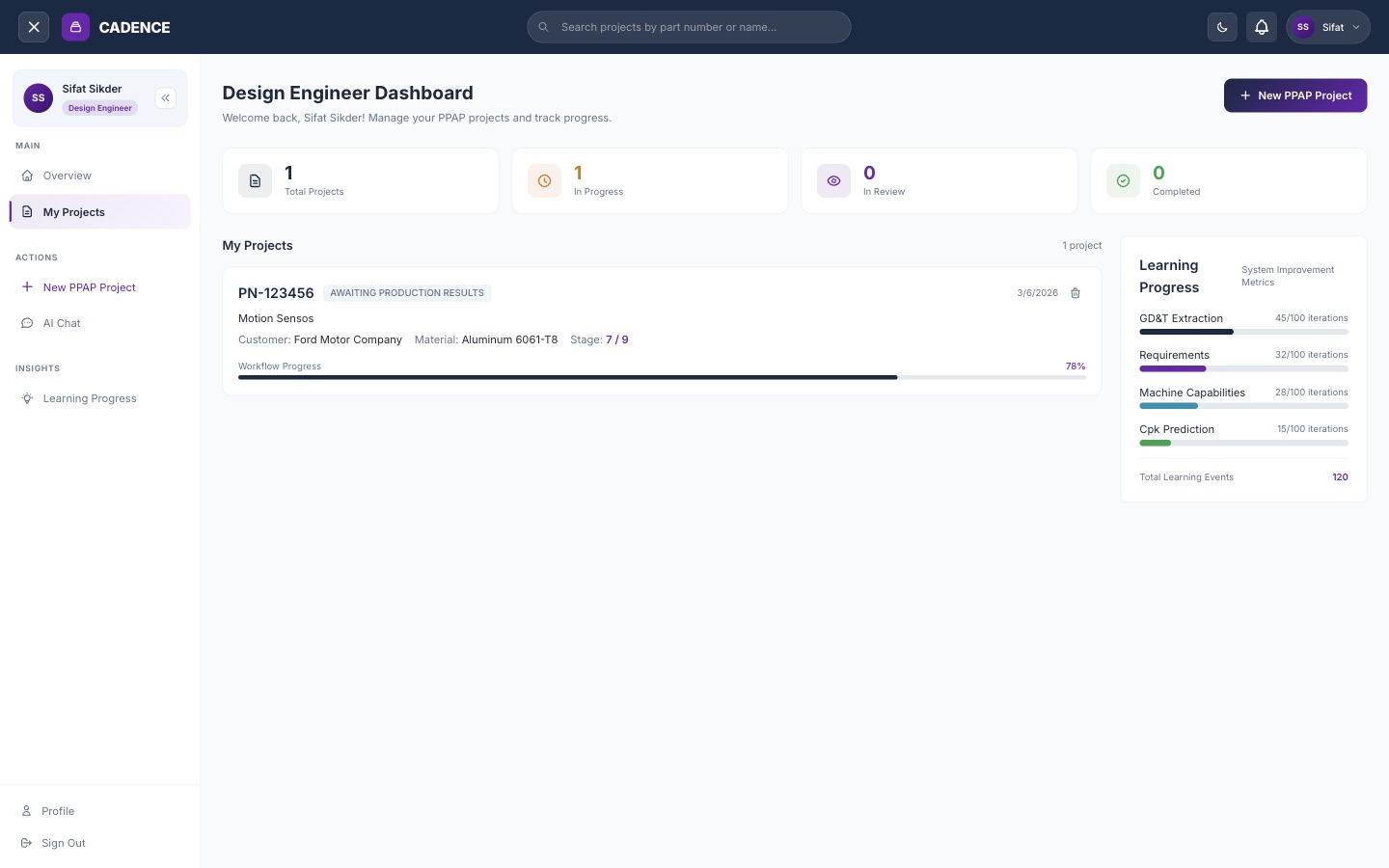
The first CADENCE arm is running as a pilot for Tier 1 automotive suppliers. Upload a drawing and the agents check capability, resolve gaps and assemble the PPAP package, with an engineer approving every decision. These are screens from a real run on a NIST test part.
Review & decide
| Option | Min Cpk | Avg Cpk | Lead time | Tier 2 suppliers | Risk |
|---|---|---|---|---|---|
| Balanced Recommended · selected | 1.66 | 1.97 | 18 days | 2 | Low |
| Multi-supplier | 1.66 | 2.02 | 21 days | 4 | Low |
| High reliability | 1.66 | 2.21 | 25 days | 1 | Low |
| Cost-optimised | 1.56 | 1.84 | 14 days | 1 | Medium |
Why the agents recommend Balanced
"Best trade-off between reliability, cost and supplier flexibility. Tolerances relaxed moderately to achieve Cpk well above 1.33."
Values from the same pilot run. The engineer can override any feature with a reason, and the agents re-check the whole configuration.
The agent team
Each agent behaves like an expert colleague with one job. When a check fails, the orchestrator starts a re-optimisation cascade and the agents work the problem together until they have options worth a human's time.
Project manager
Runs the workflow, detects capability gaps, starts the cascade and decides when to hand over to a person.
Design engineer
Reads drawings with vision AI, extracts GD&T and proposes tolerances that still preserve the part's function.
Manufacturing engineer
Predicts Cpk for each feature on each machine and flags anything below the 1.33 threshold.
Procurement manager
Checks qualified Tier 2 suppliers, certifications and whether a single-source risk is hiding in the plan.
Compliance auditor
Validates every option against AIAG PPAP, ISO 2768 and OEM-specific requirements, and flags risk.
Documentation specialist
Generates PFMEA, Control Plan, Process Flow and PSW aligned line by line, and keeps the audit trail.
Inside a re-optimisation cascade
Illustrative exchange from the brake-bracket demo scenario.
Who it is for
CADENCE gives each role in the PPAP chain its own view of the same project, so design, manufacturing and quality work from one source of truth instead of three spreadsheets.
Tier 1 suppliers
Built for the teams at automotive suppliers who prepare PPAP submissions for OEMs, and for any manufacturer whose tolerances have to be proven before production.
Design engineers
See capability while you design, and choose from options rather than discovering failures.
Manufacturing engineers
Validate machine choices and feed production results back so predictions improve.
Quality engineers & managers
Aligned documents, a completion checklist and a full audit trail before you sign.
Technical capabilities
CADENCE is a multi-agent system on Google Cloud, built to slot into an existing engineering stack and to grow one integration at a time.
Agents built on Google's Agent Development Kit call each other as tools, sharing session state and long-term memory.
Reads PDF drawings and extracts datums, feature control frames and dimensions using multi-model vision (Gemini, Claude, GPT), with chat-based correction.
Cpk prediction from a four-level knowledge hierarchy: industry baseline, machine capability, similar features and exact historical matches.
Triggers automatically below Cpk 1.33 and returns four ranked configurations: balanced, high reliability, cost-optimised and multi-supplier.
Ballooned drawing, DFMEA, PFMEA, Process Flow, Control Plan, customer requirements and PSW, exported to Excel and PDF and bundled as one package.
Every recommendation can be questioned. Answers come in layers: the rule applied, the reasoning, the evidence and the counterfactual.
Agent actions, tool calls and human decisions stream to the interface in real time and are stored with who, what, when and why.
Engineer overrides and real production results feed back into the knowledge base, so each factory's predictions improve over time.
JWT authentication, role-based access for design, manufacturing and quality, tenant-aware data, and files held in private cloud storage.
The CADENCE evolution
CADENCE grows one arm at a time. Each arm proves its value on a real process before the next one connects, so the second brain is built on evidence, not slides.
Design-to-manufacturing capability checks, agent negotiation and generated PPAP packages.
Available now · pilotAgents inside ERP, MES and APS bring orders, routings and schedules into every decision.
Coming nextIoT and CMM data stream real capability, so predictions are checked against the floor continuously.
Coming nextRobots, machines and AMRs receive intent from the AI OS and act on it, with people in charge.
VisionResponsible AI
Safety-critical parts need accountable people. CADENCE shows its reasoning, records every step and never signs anything on your behalf.
Engineers choose between options and can override any feature with their own constraint and reason.
Human in the loopAsk why and get the rule, the reasoning and what would have changed the answer.
ExplainableWhen an auditor asks why a tolerance changed, the answer is one click away.
Audit-readyThe RaiDOT assurance agent checks options against AIAG PPAP, ISO 2768 and OEM requirements.
AssuredStart here
Bring a drawing and the machines you plan to run it on. We will show you where the capability gaps are and how CADENCE closes them.
We will be in touch shortly to find a time that suits you.